Quick Start
If you don't have have access to the docker image or don't have access to the android sdk repository, please contact us at info@silencelaboratories.com.
Here is how you can setup the Mobile SDK and perform MPC operations in less than a minute.
You will create a working MPC two-party setup, where the first party, an Android application interacts with Trio Servers as a second party, and third party.
What you'll build
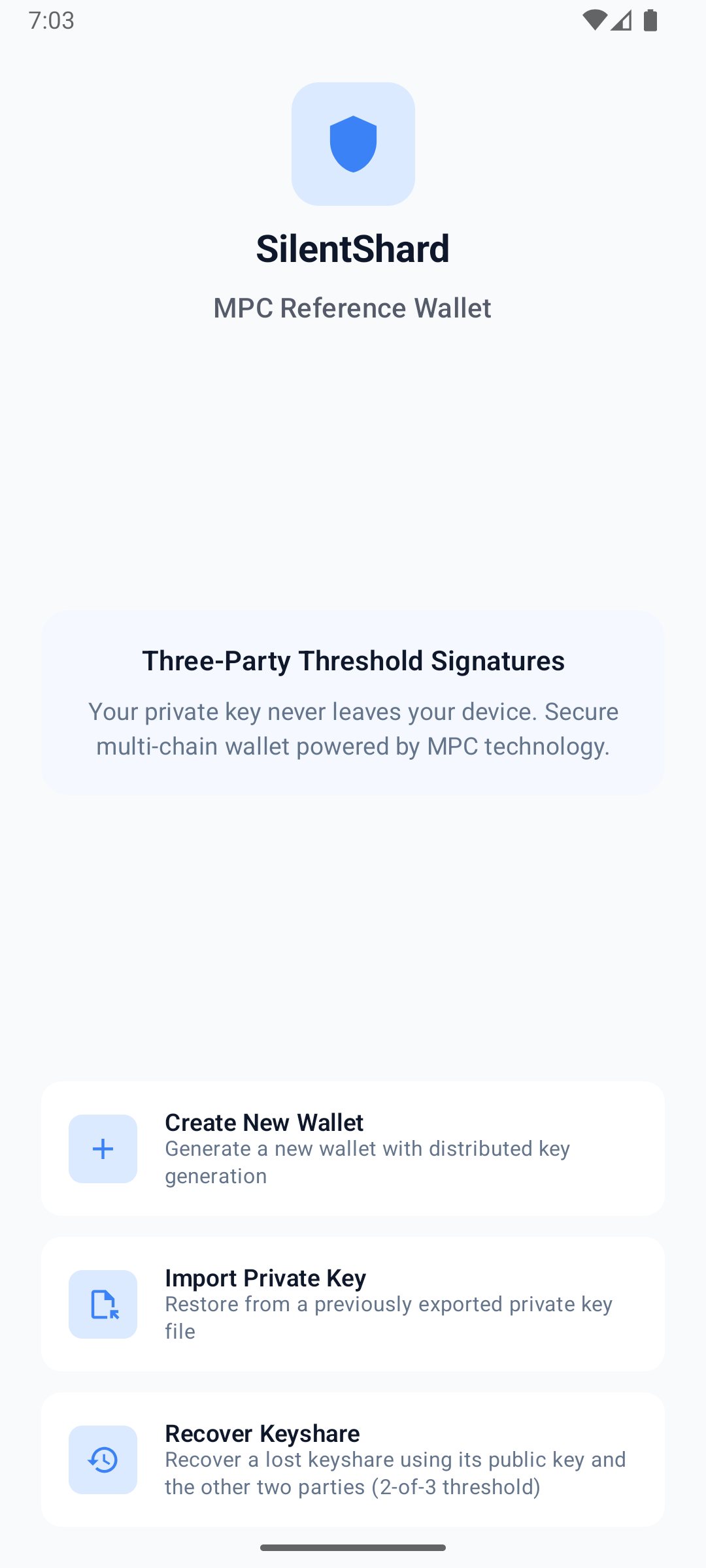
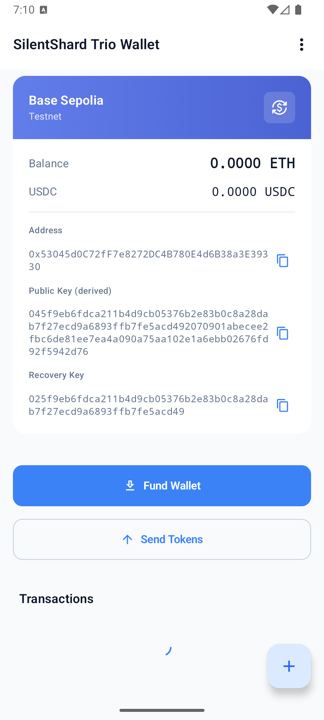
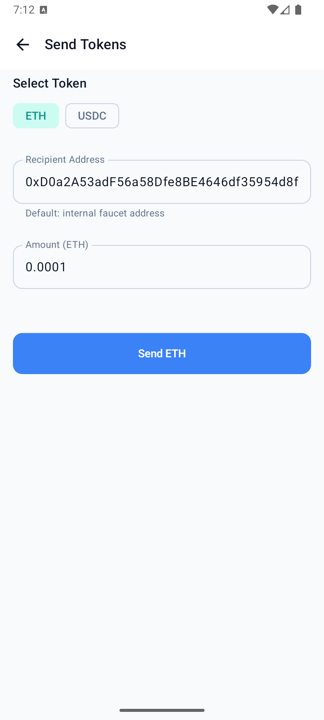
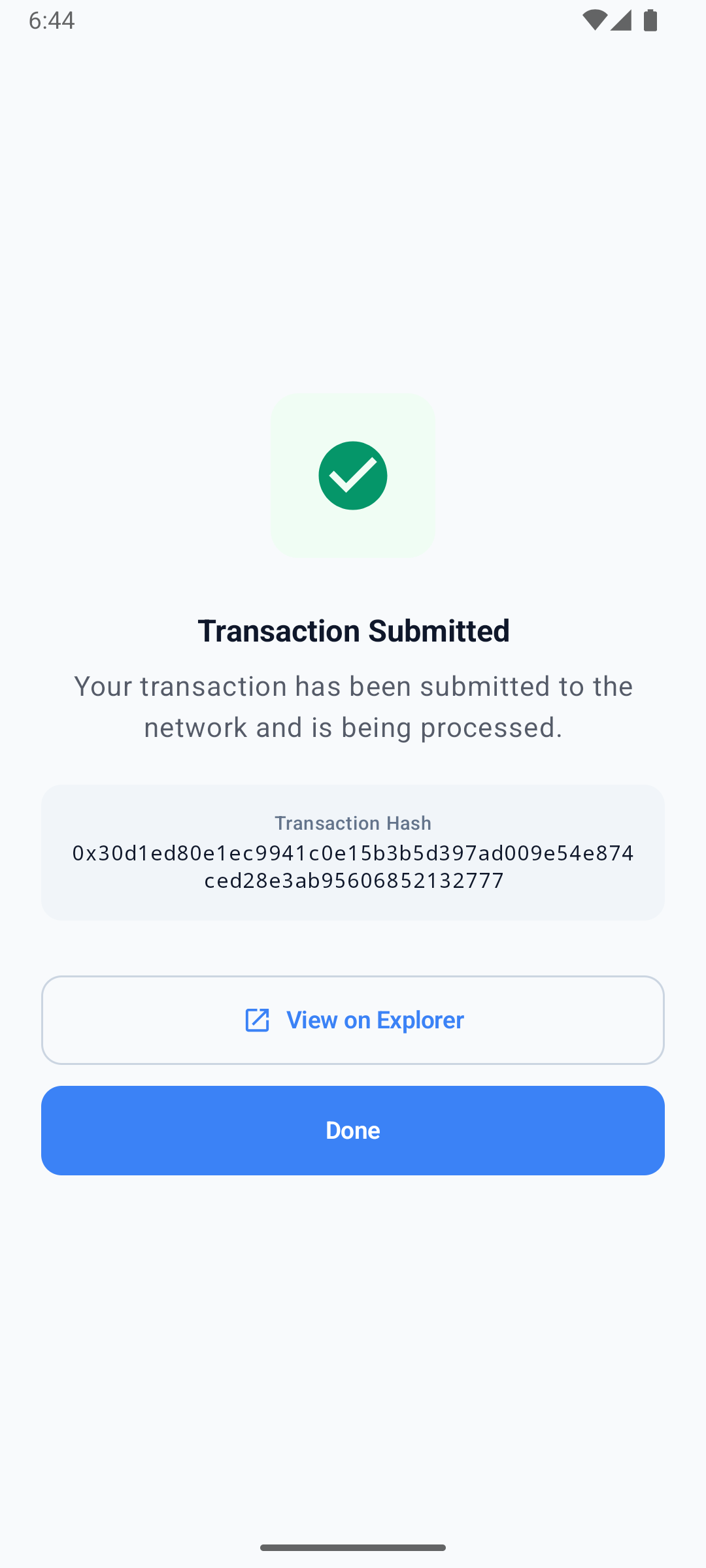
The example-hub reference wallet is a complete Android app that creates a 3-party, 2-of-3 MPC wallet and signs real Ethereum (Base Sepolia) and Solana (Devnet) transactions. This guide walks through its core MPC code — session setup, keygen, and signing. Clone the app to run the whole thing: wallet UI, funding, and on-chain transactions.
Prerequisites
For quick testing, the demo server is already deployed at trio-server.demo.silencelaboratories.com. We are using this server for the quickstart guide.
The Cloud Verifying Key for the demo server is 9c4c79e942bbc3ff1d6ace7256404d701498056978cc4638c35832acdf821b1e.
The Cloud Node Endpoint for the demo server is https://trio-server.demo.silencelaboratories.com.
Setup the Mobile SDK (Android)
The quickest way to get running is to clone the reference app and launch it:
git clone https://github.com/silence-laboratories/examples-hub.git
cd examples-hub/silent-shard-sdk/with-android/trio-initiator
Add your GitHub Packages credentials to local.properties (see Dependency Installation below for the read-only token), then open the project in Android Studio and run it on a device or emulator. It talks to the public demo server out of the box, so you can create a wallet and sign a transaction right away. The full file-by-file walkthrough (keygen, signing, export, key refresh, and more) is in Android & iOS reference apps.
Session Creation
A TrioSession is the handle for all MPC operations (keygen, sign, and so on). The reference app builds one session per algorithm inside its VaultSessionManager:
// HardwareMessageSigner is the app's own implementation of the SDK's MessageSigner
// interface, signing with a hardware-backed key (Android Keystore).
private val messageSigner = HardwareMessageSigner()
private val websocketConfig = WebsocketConfig(url = DEMO_SERVER_URL, port = DEMO_SERVER_PORT, isSecure = true)

// EncryptedStorageClient is the app's own implementation of the SDK's StorageClient
// interface. Since that interface carries a keyType, ECDSA and EdDSA keyshares are
// persisted through separate clients — one per algorithm.
private val ecdsaStorage = EncryptedStorageClient(store, KeyType.ECDSA)
private val eddsaStorage = EncryptedStorageClient(store, KeyType.EdDSA)

// One TrioSession per algorithm, each bound to the message signer, the cloud
// verifying key, the websocket config, and its storage client.
private val ecdsaSession: TrioSession =
    SilentShard.ECDSA.trioInitiator(messageSigner, CLOUD_VERIFYING_KEY, websocketConfig, ecdsaStorage)

private val eddsaSession: TrioSession =
    SilentShard.EdDSA.trioInitiator(messageSigner, CLOUD_VERIFYING_KEY, websocketConfig, eddsaStorage)
HardwareMessageSigner and EncryptedStorageClient are not SDK types — they are the reference app's own implementations of the SDK's MessageSigner and StorageClient interfaces (hardware-backed P-256 signing and encrypted keyshare storage). Supply your own implementations, or clone the example-hub app to use these as-is.
Run the MPC operations
After creating the session, you can perform MPC operations.
Key Generation
Generate MPC keyshares with the keygen method. It returns a keyId (a String); the SDK persists the keyshare to your StorageClient and every later operation is addressed by that keyId. Here is how the reference app does it:
suspend fun keygen(keyType: KeyType): KeyResult {
    Log.i(TAG, "Keygen started for type: ${keyType.name}")

    // sessionFor(...) is this app's own helper (not an SDK method) — it returns the TrioSession
    // we created earlier for this algorithm (ECDSA or EdDSA).
    val session: TrioSession = sessionFor(keyType)
    // keygen() is the SDK call: runs the MPC protocol, persists the keyshare to your
    // StorageClient, and returns the keyId that addresses it.
    val keyId = session.keygen().getOrThrow()
    val publicKey = extractPublicKey(keyId)

    Log.i(TAG, "Keygen completed for keyId: $keyId")
    return KeyResult(keyId, publicKey)
}
Signature Generation
Sign a message using the sign method, passing the keyId returned from keygen:
suspend fun sign(keyId: String, message: ByteArray, derivationPath: String): ByteArray {
    val dao = readDao(keyId)

    // sessionFor(...) is this app's own helper (not an SDK method) — it returns the TrioSession
    // we created earlier for this key's algorithm (the stored record's keyType).
    val session: TrioSession = sessionFor(dao.keyType)
    // sign() is the SDK call: it produces the threshold signature for the key addressed by keyId.
    val signature = session
        .sign(keyId, message.toHex(), derivationPath)
        .getOrThrow()

    Log.i(TAG, "Sign completed (${signature.size} bytes, type=${dao.keyType.name})")
    return signature
}
The HardwareMessageSigner, EncryptedStorageClient, and WebSocket client shown are the reference app's implementations — hence for reference only, not a recommendation. Provide your own for production.
Setup your own app
Prefer to wire the SDK into your own app instead of the reference project? Create a new Android Studio project by following the official guide (or use an existing one), then add the SilentShard dependency.
Dependency Installation
Step 1: Create access token for the repository
- Get access to the repository https://github.com/silence-laboratories/silent-shard-artifacts from the Silence Laboratories team.
- Create a personal access token at https://github.com/settings/tokens with the following scopes
checked[✓] to access the repository, and it's
associated GithubPackages
through gradle.
- Under
repo-> [✓]public_repo - Under
write:packages-> [✓]read:packages
We can leavewrite:packagesuntouched/unchecked as we only need read access - It will end up looking like this : Two items checked everything else unchecked. See below.
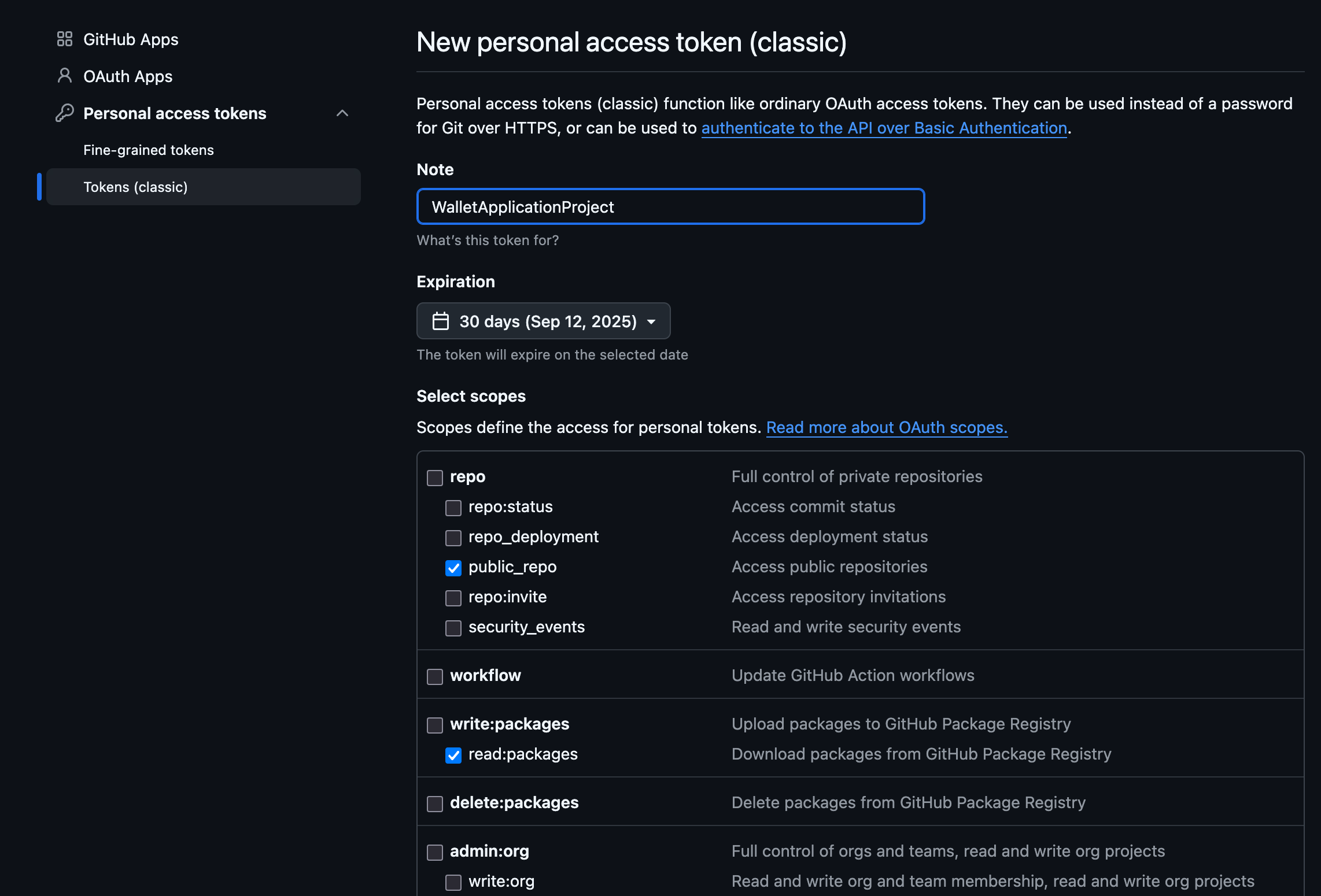
- Under
Step 2: Configure settings.gradle.kts
- Add the silentshard maven repo with the access credentials under the dependencyResolutionManagement -> repositories.
  dependencyResolutionManagement {
  repositoriesMode.set(RepositoriesMode.FAIL_ON_PROJECT_REPOS)
  repositories {
      google()
      mavenCentral()
      maven {
          url =
              uri("https://maven.pkg.github.com/silence-laboratories/silent-shard-artifacts")
          credentials {
              username = "github_username"
              password = "token_we_just_created"
          }
      }
  }
  }
Step 3: Configure app level build.gradle.kts
Add the silentshard dependency in your dependencies block:
dependencies {
  implementation("com.silencelaboratories.silentshard:trio:1.0.0")
}
Step 4: Gradle-Sync
- Sync gradle with project files.
Android Manifest
The SDK communicates with the cloud node over the network, so add the internet permission to your AndroidManifest.xml:
<uses-permission android:name="android.permission.INTERNET" />
With the dependency in place, wire it up the same way the reference app does — create a session, then run keygen and signing.